Want to learn programming but don't know where to begin? Python is one of the most approachable programming languages for beginners. However, in 2026, there is another important question: how should we learn programming when artificial intelligence can write code for us?
The answer isn't to skip the fundamentals. On the contrary, understanding them and learning to use modern tools effectively is more important than ever.
In this guide, we'll explore the first steps, essential Python concepts, practical exercises, and how AI can become a useful learning partner.
1. Why Choose Python?
Python is used in many fields, from automating everyday tasks and processing data to developing web applications and artificial intelligence systems.
One of its biggest advantages for beginners is its readable syntax. Instead of dealing with countless technical details from day one, you can focus on understanding programming logic.
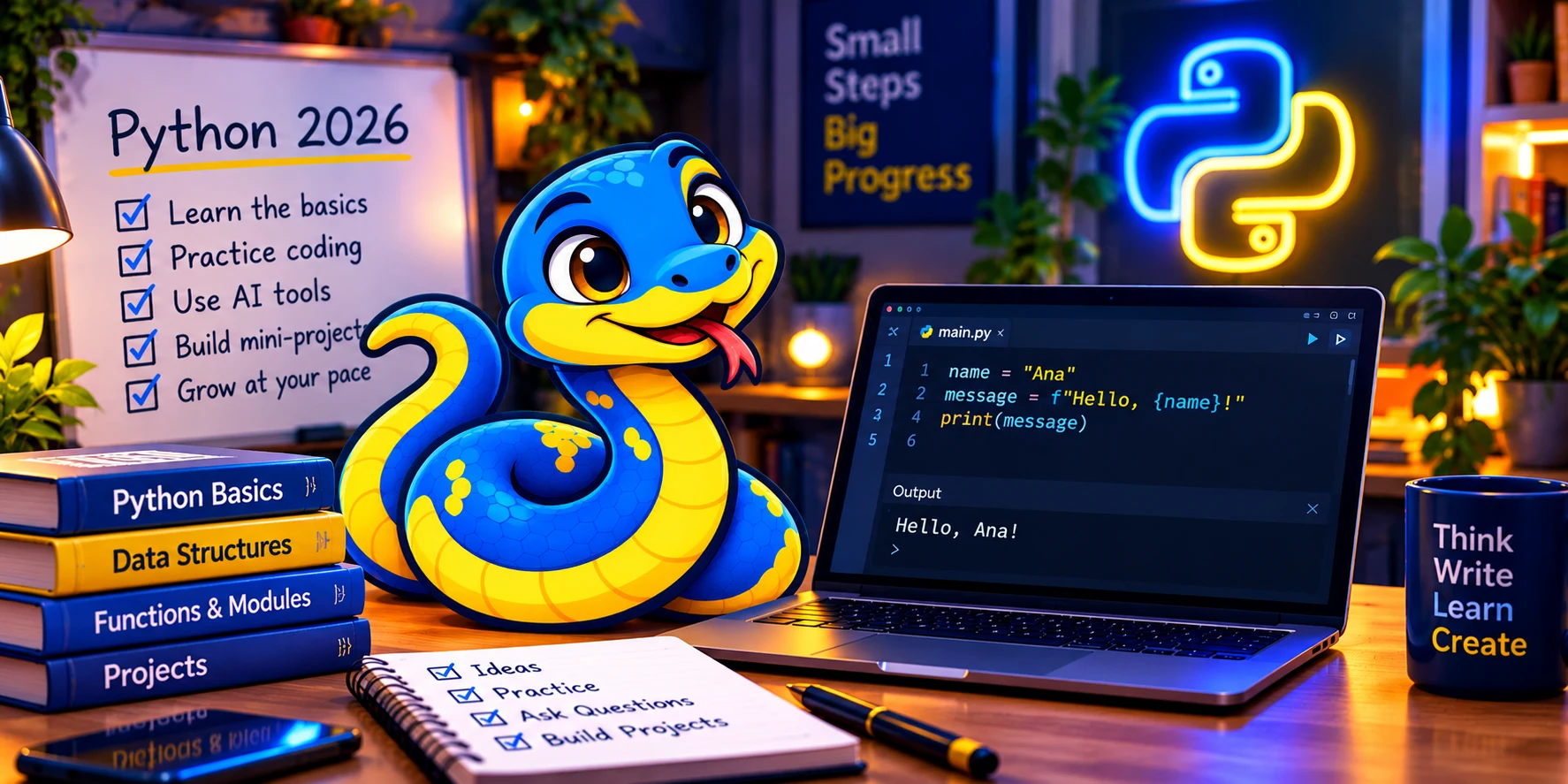
Consider this simple example:
name = "Ana"
print("Hello, " + name)
This program stores a name in a variable and displays a greeting. Just two lines of code introduce two important ideas: variables and working with text.
That's a great place to start. Your first program doesn't need to be complicated.
2. Don't Try to Learn Everything at Once
One of the most common beginner mistakes is skipping the fundamentals. Some people want to build an AI application immediately, others want to create an online store or automate data processing.
These are great goals, but learning becomes much easier when you follow a logical sequence.
Start with these concepts:
- Variables and data types — how programs store and process values.
- Operators and conditions — how programs compare data and make decisions.
- Loops — how to repeat operations efficiently.
- Collections — how to organize groups of related values.
- Functions — how to divide programs into reusable parts.
Once you understand these foundations, working with files, JSON data, libraries, and more advanced applications becomes much more approachable.
3. Learn to Read Code Before Writing Complex Programs
Programming isn't just about writing instructions. A good programmer also understands what happens when those instructions run.
Look at this example:
numbers = [2, 4, 6]
total = 0

for number in numbers:
    total += number

print(total)
Before running the program, try answering three questions:
- What is stored in the
numbersvariable? - How many times will the loop body execute?
- What value will
print(total)display?
The correct result is 12, but explaining how the program reaches that result matters more than simply knowing the answer.
This kind of exercise helps you develop programming logic rather than merely copying examples.
4. Use Artificial Intelligence as a Mentor, Not a Replacement for Thinking
In 2026, AI tools are part of everyday software development. They can explain code, identify bugs, generate examples, and help explore different approaches.
However, how you use these tools makes a significant difference.
Instead of asking:
"Write the complete program that solves this assignment."
Try questions like:
- "Explain this Python code step by step."
- "Don't give me the solution. Guide me with questions instead."
- "Where is the mistake in my reasoning?"
- "Give me a simpler exercise using the same concept."
- "Ask me a question to check whether I understand loops."
This approach turns AI into a learning assistant rather than a shortcut around learning.
5. Build Small Projects as Early as Possible
You don't need to master all of Python before building something useful.
Once you're comfortable with variables, conditions, loops, and collections, try creating:
- A simple quiz — ask questions, check answers, and calculate a score.
- An expense tracker — store expenses and calculate the total.
- A student manager — organize names and basic information.
- A calculator — perform basic mathematical operations.
Your first projects don't need to look impressive. Their real value comes from combining different concepts and solving problems independently.
Real skills develop not only through watching tutorials, but also through experimenting, making mistakes, debugging, and trying again.
6. Create a Realistic Learning Plan
There is no single learning schedule that works for everyone. However, you can begin with a simple four-week plan:
- Week 1: variables, data types, operators, and simple programs.
- Week 2: conditions, loops, and basic collections.
- Week 3: lists, dictionaries, and functions.
- Week 4: review, practical exercises, and your first mini-project.
Think of this as a starting framework, not a promise that you'll master Python in four weeks. Some learners will need more time, and that's perfectly fine.
What matters most is consistency and returning to concepts you haven't fully understood yet.
7. How Can Python AI Tutor Help?
These principles inspired us to develop Python AI Tutor, an educational platform within IT Komuna.
The first level, Python Foundations, includes 22 concepts organized into five modules, with hands-on exercises, understanding checks, and progress tracking.
You'll also meet Sloby, an AI mentor who helps you understand concepts, ask better questions, and analyze your code.
The idea is simple: we don't learn Python just to write programs. We learn to understand what we're doing and gradually become more independent.
Conclusion: The Best Time to Start Is Now
You don't need advanced mathematics, previous programming experience, or an immediate understanding of every technical term.
What you need is curiosity, a willingness to experiment, and the motivation to solve problems.
Artificial intelligence can help you learn faster and find explanations more easily, but genuine understanding comes from your own practice.
Start small. Understand each concept. Write code. Make mistakes. Debug. Keep going.